


A new Founders' Relief on selling your business
What was announced:
A new capital gains tax relief from 6 April 2027. Qualifying founders, and significant early investors, will pay 10% tax on gains from selling their shares, up to a lifetime limit of £10 million.
To qualify, the founder must:
- have held at least 25% of the company's ordinary shares when it started trading (or began preparing to trade)
- have held those shares for at least five years before the sale
- have been a UK tax resident for at least five consecutive tax years before the sale.
The company must:
- be a UK trading company still carrying on broadly the same trade it started with
- have turnover of at least £10 million and at least 15 qualifying full-time employees in the accounting period before the sale
- pass two of three growth and innovation tests:
- average turnover growth of 25% a year over three consecutive accounting periods, starting from at least £10 million
- average headcount growth of 25% a year over three consecutive accounting periods, starting from at least 15 employees
- at least £1.5 million of qualifying R&D spend, with R&D relief claimed, in the three years before the sale.
The growth periods can fall at any point in the ten years before the sale.
What it means for founders:
No agency under £10 million turnover will qualify. Without a substantial R&D claim, an agency needs to have grown from at least £10 million to roughly £19.5 million over three years, so in practice this relief is aimed at scale-ups. Agencies with genuine technology or product development have a further route, but if HMRC later overturns the R&D claim, the relief can be withdrawn with interest.
Founders who held less than 25% when trading began will not qualify. The staff test counts qualifying full-time employees, so check how directors, contractors and freelancers are treated before relying on it. If you will qualify, it could be worth waiting until after 6 April 2027 to sell. The consultation closes on 30 November 2026, so there is still a chance to influence how the rules are drawn.
Business Asset Disposal Relief is cut in half
What was announced:
The lifetime limit for Business Asset Disposal Relief (BADR) falls from £1 million to £500,000 for sales on or after 6 April 2027. The rate stays at 18%.
What it means for founders:
BADR is the relief most agency founders use when they sell. For higher and additional rate taxpayers, it means the first slice of the gain is taxed at 18% instead of 24%, and that slice is shrinking to £500,000. The government says three in four BADR claimants will be unaffected.
If you don't qualify for Founders' Relief and expect a gain above £500,000, selling before 6 April 2027 could save you up to £30,000. That is worth having, but it is not a reason to rush into a poorly priced deal. A good deal usually takes several months, so if this date matters to you, the planning needs to start now. There will be special rules for deals agreed before 6 April 2027 that complete afterwards, and anti-forestalling rules may also apply, so take advice on timing.
How the numbers compare:
Illustrative tax on a gain, assuming a higher-rate taxpayer who has not used any relief before, and ignoring the £3,000 annual exempt amount.
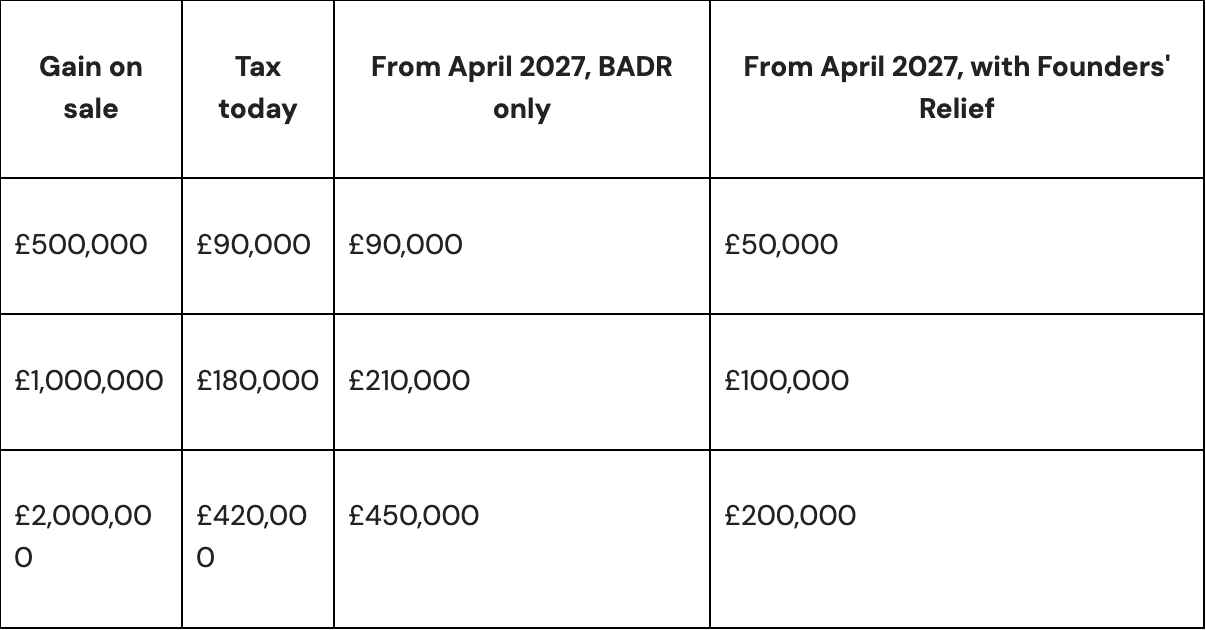
Founders' Relief, BADR and Investors' Relief share one lifetime limit. Any BADR or Investors' Relief you claim from April 2027 reduces the £10 million available under Founders' Relief.
Capital gains tax rates stay the same
What was announced:
The main capital gains tax rates are unchanged at 18% and 24%. Calls to raise them to match income tax rates were not taken up.
What it means for founders:
The outcome many founders feared has not happened. The tax rate on gains from selling your business is still lower than the tax rate on a salary of the same value.
No rise in income tax, National Insurance or dividend tax
What was announced:
No increases to income tax, National Insurance or dividend tax rates. Income tax and National Insurance thresholds stay frozen until April 2031, and dividend rates stay at the 10.75% and 35.75% introduced in April 2026. Employer National Insurance and the £10,500 Employment Allowance are unchanged. The National Living Wage rises 3.9% to £13.21 an hour from 1 April 2027.
What it means for founders:
You do not need to rethink how you pay yourself. Staffing costs, usually an agency's biggest expense, get no relief, and the wage floor rises again in April, so pricing and margin discipline matter as much as ever.
One to watch: the government will reform how company distributions are taxed from April 2028, targeting arrangements that take profit out at capital gains rates, such as a new holding company followed by a share buyback. If a buyback or partial exit is in your plans, raise it with your adviser now.
Higher tax on savings and property income
What was announced:
Tax on savings and property income rises by a further two percentage points from April 2027, on top of the two-point rise announced last year. The new rates are 24%, 44% and 49%, up from 20%, 40% and 45% today.
What it means for founders:
This hits founders who own their office personally and rent it to the agency, those who lend money to their agency and charge interest, and those holding large cash balances in their own name. Review these arrangements with your accountant before April 2027. If you are based in Scotland or Wales, check how the property income rates apply to you.
Business rates: no change for agency offices
What was announced:
The full small business rate relief threshold rises from £12,000 to £18,000 of rateable value, but only for retail, hospitality and leisure properties in England.
What it means for founders:
Agency offices are not covered, despite the headlines. Standard small business rate relief is unchanged: full relief up to £12,000 of rateable value, tapering to nothing at £15,000.
Bigger tax relief on equipment
What was announced:
The first-year allowance on main-rate assets rises from 40% to 50% from 1 January 2027. The main writing-down allowance falls from 14% to 12% from April 2027.
What it means for founders:
This mainly helps unincorporated businesses and leasing businesses. Most limited company agencies can already deduct the full cost of new equipment through full expensing, which continues, so the impact will be small.
Higher mileage rates for business travel
What was announced:
The tax-free mileage rate of 55p per mile for the first 10,000 business miles, introduced as a temporary rise from 45p earlier this year, is now permanent. The rate above 10,000 miles rises from 25p to 35p from 6 April 2027.
What it means for founders:
A small benefit for agencies whose teams travel heavily to clients. Update your expenses policy.
The wider economy
What was announced:
Fiscal headroom falls to £15 billion in 2029/30, down from £23.6 billion in the March forecast, driven by higher borrowing costs and the conflict in the Middle East. The OBR nudged this year's growth forecast up to 1.2% but expects just 1.0% next year. The deficit is forecast at 4.2% of GDP this year.
What it means for founders:
The government has less room to manoeuvre, growth next year is expected to be weak, and borrowing is more expensive. Clients may stay cautious with budgets, so revenue concentration and retention deserve close attention. Buyers who fund acquisitions with debt face higher costs, which can make them more careful on price. Agencies with clean numbers, recurring revenue and low reliance on the founder will continue to attract the strongest offers.
Personal savings and ISAs
What was announced:
The planned cut to the cash ISA allowance has been reversed, so the £20,000 annual allowance stays. The government will work with industry on a new incentive for first-time investors, and a First-Time Buyer ISA replaces the Lifetime ISA from April 2029.
What it means for founders:
A useful tax-free home for money you take out of the business, particularly as tax on other savings income is rising.
What to do now
- Work out whether you could qualify for Founders' Relief. That single answer tells you whether to aim for before or after 6 April 2027. Most agencies will not, so run the numbers rather than assume.
- If you will not qualify and expect a gain above £500,000, test whether a sale before April 2027 is realistic. Up to £30,000 is worth having, but not at the cost of a weaker price or rushed due diligence. Deals take months, so preparation starts now.
- Check your cap table. The 25% test looks back to when trading began, so early co-founder splits matter as much as future investment.
- Review property and savings arrangements with your accountant before April 2027, including any rent you charge the agency or interest on loans to it.
- Have your say. The Founders' Relief consultation closes on 30 November 2026. As currently drafted, it favours tech scale-ups over services businesses.
Whichever side of April 2027 you sell, tax is the smaller lever. For most agencies, the £30,000 at stake under BADR is modest next to what is won or lost on price, and price follows the fundamentals: forecastable numbers, recurring revenue, low client concentration and low reliance on the founder. Those are what buyers pay for, and they take longer to fix than a sale date.