
.svg)
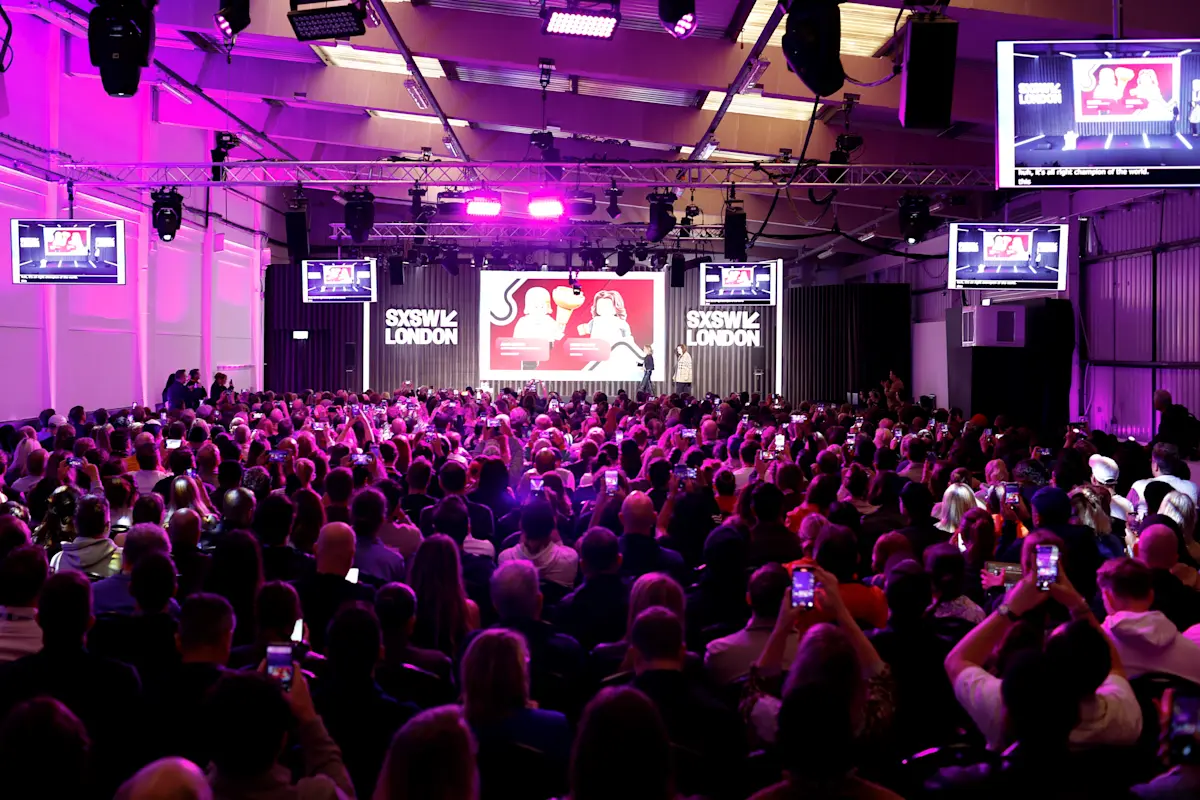
SXSW London 2026 wrapped a few weeks ago. Our Chief Marketing and Growth Officer Charlie Eyeington was in the room across the sessions, and came back with a clear read on where the industry is heading.
The official theme was "The Future Belongs to the Deeply Human." But if you tracked what the speakers were actually saying across the week, a sharper picture emerged.
Two years ago, every conference was still asking whether AI would change agency work. SXSW took that as settled. The question has moved on to what survives the shift, what gets repriced, and which parts of the agency's value compound when the underlying technology stops being the differentiator.
Across Society Rewired, Creator Economy, Marketing and Advertising, and AI and The New Human Experience, here's what stood out - and what it means for agency founders.
The mediocre middle is gone
The strongest line of the week came from David Droga in conversation with Matthew Freud.
AI will devour the generic, formulaic work that clutters the industry. The middle layer of execution - the version any agency could produce with enough people and enough revision rounds - is being absorbed into the platforms themselves. What's left at the top is original creative judgement. What's left at the bottom is automation.
The middle, where most agency revenue still lives, is the part that's disappearing.
This isn't a creative philosophy point. It's a commercial one. Droga's argument was that AI is a predictive tool. It can only generate an average of what's already been done. Breakthrough work - campaigns that create new categories rather than reflecting existing ones - comes from human instinct, flaws, and judgement. Agencies competing on execution efficiency are competing for the work AI is actively replacing. Agencies competing on judgement and originality are competing for work AI structurally can't do.
The Unusual Method maps this directly. If your team is mostly producing the middle layer, the next 18 months will get harder. If your team is mostly producing the top layer, the same window will get significantly more valuable.
Lean agility is now the production model
Sam Thompson and Ben Hacker from Content Jungle made the operational version of the same argument.
Traditional agencies arrive at shoots with 50-person crews and full edit suites. Creators arrive with one videographer and an idea. The output is increasingly comparable. Sometimes the creator's version performs better, it's native to the platform and free of the corporate sign-off layer that smooths out everything interesting.
The shift isn't that creators are replacing agencies. It's that agencies built around heavy production models are pricing themselves out of work that doesn't need it.
The agencies in our collective that have repositioned around lean, idea-first delivery are running materially better margins than those still selling the full production stack. Same client outcomes. Different cost base. This isn't a single-quarter fix. It's a multi-year structural shift in how the business is built.
Safe advertising is the expensive option
Jon Evans from Uncensored and Adam Morgan from eatbigfish ran one of the sharper sessions of the week.
Their argument: the organisational immune system that kills bold ideas through endless approval rounds isn't producing safer outcomes. It's producing more expensive ones. Dull advertising costs brands millions in additional media spend just to be noticed, because the work isn't doing its share of the lift. Bold work is cheaper because it punches through.
For agency founders, the conviction-versus-compromise gap shows up in your own work too. The agencies that produce premium work, charge premium rates, and exit at premium multiples are the ones who hold the line on conviction even when it costs them in the short term. The ones who compromise to keep clients happy in every cycle erode the work, the rates, and eventually the multiple.
Worldbuilding beats transactional partnerships
Leandro Barreto from Unilever Beauty made the case that brands shouldn't build everything from scratch. The strongest move is to extend the brand by participating in worlds that already exist. Multi-year partnerships, deep community infrastructure, real-world integration over time.
This is structurally different from the transactional influencer model most agencies are still selling. One-off posts. Campaign-by-campaign deals. Performance metrics measured in days rather than years.
The agencies pulling premium rates aren't selling tactics. They're selling structural positioning that takes years to build and can't be replicated by a competitor in a quarter.
The decentralised internet is no longer theoretical
Rose Wang from Bluesky walked through where social media is heading.
The attention-capture, rage-bait model that's powered the major platforms for a decade is breaking. What's replacing it is a decentralised model where users control their own identity, define their own moderation rules, and use AI to build custom feeds curated around genuine interests rather than algorithmic outrage.
This matters for agencies because the channel logic that's underpinned digital strategy for fifteen years is shifting. If your clients' audiences are moving toward user-owned, niche-curated environments, the playbook that worked on the major platforms doesn't transfer. The targeting model changes. The content model changes. The measurement model changes.
Mattering is the real ROI
Jennifer B. Wallace from The Mattering Institute and Kasley Killam made the most counterintuitive argument of the week.
The more technology isolates people, the more durable the value of real-world community becomes. Consumers want to matter. They want to feel significant, connected, depended upon. No algorithm replicates that. No AI generates it. The brands building lasting category positions in 2026 aren't the ones with the biggest media spend. They're the ones with the deepest real-world community infrastructure.
For agency founders, this is a strategic opportunity most aren't priced for yet. The clients who get the worldbuilding and community shift will pay premium rates to the agencies who can credibly deliver against it. The agencies still optimising paid social campaigns will compete on price against everyone else doing the same thing.
The Unusual take
The themes from SXSW London 2026 weren't really about AI, or creators, or platforms. They were about what survives when the technology stops being the differentiator.
The answers were consistent across every track. Judgement survives. Originality survives. Lean operating models survive. Deep community presence survives. Conviction survives. The middle layer of execution doesn't.
The agencies that reposition toward judgement, originality, lean delivery, and genuine market presence will pull ahead. The ones still selling middle-layer execution will spend the next three years competing with platforms and AI for work being absorbed underneath them.
The diagnosis isn't hard. The implementation almost always requires senior input the founder can't credibly provide alone. That's where most agencies stall.
.jpg)

.jpg)